

Educational / Explainer
Jan 7, 2026
Why “Lowest Price” Is a Myth: A Technical Look at Federal Source Selection

Justin Zloty

Introduction
In federal contracting, a common misconception is that the Government always chooses the lowest-priced offer. In reality, the acquisition regulations and practices paint a more nuanced picture, where “lowest price” is often a myth rather than an absolute rule. The Federal Acquisition Regulation (FAR) emphasizes that best value, not just lowest cost, drives source selection decisions. Agencies are required to consider factors like technical quality, past performance, and risk in addition to price. This article provides a technical examination of the federal source selection process to demonstrate why the lowest price is not always the winning factor.
We will explore the procurement workflow, timeline, evaluation methods, and decision logic trees that contracting professionals use, supported by citations from the FAR (including provisions on Lowest Price Technically Acceptable (LPTA) source selection and Time-and-Materials (T&M) contracts) to dispel the myth of lowest price.
(For information on identifying solicitation-specific contract mechanisms, see [next article].)
Best Value Continuum: Tradeoff vs. LPTA
The FAR introduces a “best value continuum” of source selection approaches, ranging from Lowest Price Technically Acceptable (LPTA) to tradeoff strategies. Under a tradeoff (best value) process, the government may accept a higher-priced offer if it provides superior value or quality; in contrast, under LPTA, award goes to the lowest-priced proposal that meets the minimum technical requirements. While LPTA might seem to favor the lowest bidder, its usage is heavily restricted. According to FAR 15.101-2, the LPTA method is only appropriate when the Government expects no additional value from proposals exceeding the minimum requirements and can clearly define those minimum acceptability standards. In an LPTA procurement, proposals are evaluated on an acceptable/unacceptable basis for all non-price factors, and no tradeoffs are permitted (i.e. an offeror cannot win by being superior, only by being acceptable and cheapest).
However, the idea that agencies routinely pick the lowest price is a myth because often LPTA is not used for complex or critical acquisitions. In fact, Congress and the FAR have placed limits on LPTA. FAR 15.101-2 ⟮c⟯ enumerates strict conditions for using LPTA (e.g. requirements must be clearly described, technical offers expected to be indistinguishable except for price, etc.), and contracting officers must document a justification for using LPTA. Moreover, FAR 15.101-2(d) and related statutes direct agencies to avoid LPTA for certain types of procurements where qualitative differences are important. For example, solicitations for knowledge-based professional services, complex IT or engineering, or personal protective equipment should generally not use LPTA. The rationale is that insisting on the lowest price in such cases would deny the Government the benefits of cost-technical tradeoffs – in other words, the Government might miss out on better solutions or lower long-term costs by focusing only on price. Instead, a best-value tradeoff approach allows the Source Selection Authority (SSA) to weigh higher quality against higher price and choose the proposal that offers the optimal value.
Additionally, FAR 15.304 reinforces that quality shall be evaluated in every source selection through one or more non-cost factors. Solicitations must clearly communicate the relative importance of price and other factors (e.g. whether technical merit is more important than price, approximately equal, or less important). In many cases, especially for complex or mission-critical work, agencies assign a higher importance to technical capability or past performance over price. This underscores that award is not automatically based on lowest price; the Government is often willing to pay more for a substantially superior proposal, consistent with the best value principle.
Source Selection Process: Workflow and Timeline

The federal procurement process follows a structured workflow from planning to contract award, which helps illustrate where price and other factors come into play. Figure 1 depicts a simplified buyer’s workflow for source selection. The process begins with the agency defining its requirements and acquisition strategy. At this stage, the contracting team decides the appropriate source selection approach (tradeoff or LPTA) and contract type, based on the nature of the requirement and risk. Next, the solicitation (Request for Proposals, RFP) is issued to industry. After proposals are received, the evaluation phase starts: evaluators review each proposal against the RFP’s stated criteria. They typically assess technical merit, past performance, and other non-price factors first, often through rigorous scoring or ratings. Only after determining technical acceptability or scoring the quality factors do they open and evaluate prices. Finally, the SSA makes a source selection decision based on the evaluation results, either choosing the lowest priced offer (if using LPTA and all minimum standards are met) or performing a best value tradeoff analysis to justify paying more for a higher-rated proposal. This decision is documented along with the rationale, including any tradeoffs of price vs. quality. The selected contractor is then awarded the contract, and the process concludes with notifications and debriefings to offerors.
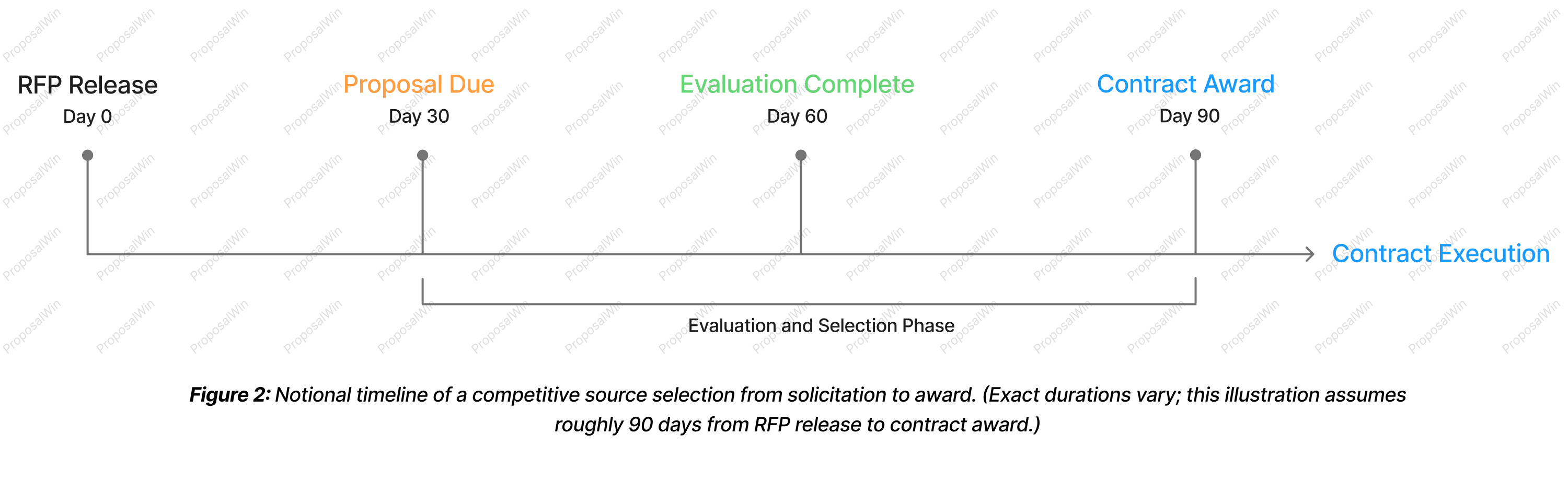
The source selection timeline can vary widely based on complexity, but it typically spans several months. Figure 2 shows a notional timeline of key phases in a competitive negotiated acquisition. The process starts with solicitation release (Day 0 in this example) and allows time for offerors to prepare proposals. After the proposal submission deadline, the evaluation phase occurs (often 30–60 days or more, depending on the number of proposals and complexity of evaluation). If a best-value tradeoff approach is used, the evaluation may involve more extensive qualitative analysis, potentially adding some time compared to a straightforward LPTA evaluation. Nevertheless, even an LPTA procurement requires thorough review to ensure each offer meets all technical acceptability criteria. Once evaluations are complete, the SSA makes the award decision, and the contract is awarded (Day 90 in the illustrative timeline). Post-award activities like debriefings or protests (not shown in the timeline) can further affect the actual dates. This timeline underscores that achieving the “lowest price” is just one part of the process: the Government must invest time in evaluating quality and making sound tradeoff decisions to ensure the chosen contractor can deliver the required outcome.
Evaluation Factors and Decision Outcomes
During source selection, agencies use evaluation factors to assess each proposal. Common factors include technical capability, management approach, past performance, and price. The Government evaluates these in accordance with the RFP’s stated methodology. One useful way to visualize the results is an evaluation matrix that compares offerors across all factors.
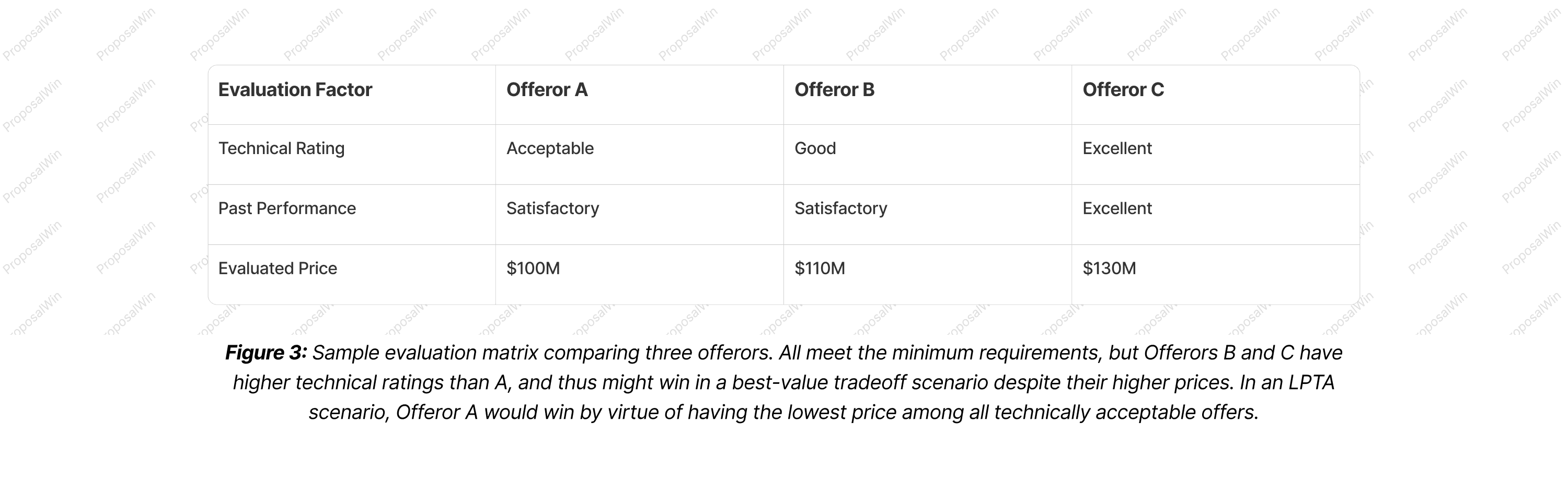
For example, Figure 3 presents a simplified evaluation matrix for three hypothetical offers. In this scenario, all offerors meet the minimum technical requirements, but they have varying levels of quality: Offeror A is rated “Acceptable” technically with satisfactory past performance and has the lowest price. Offeror B and Offeror C, however, have higher technical ratings (“Good” and “Excellent,” respectively) and also strong past performance, at higher prices. If this were an LPTA procurement, the award would simply go to the lowest priced offeror that is technically acceptable; here, that would be Offeror A, since all are at least acceptable. Cost would trump any qualitative superiority because once the minimum threshold is met, the lowest price wins by definition.
However, if using a best-value tradeoff approach, the agency can consider whether Offeror B or C’s superior technical merits justify paying a higher price. Suppose the technical factor was prioritized as more important than price in the solicitation. The Source Selection Authority might determine that Offeror C’s excellent technical solution and past performance offer significantly higher probability of successful performance, which is worth the extra cost. In that case, Offeror C could be selected over a lower-priced competitor, debunking the notion that the lowest price always wins. The FAR mandates that such tradeoff decisions be documented, including the rationale and the perceived benefits of the higher-priced proposal that merit the additional cost. This ensures transparency that the decision to forego the lowest price was deliberate and justified by value to the Government.
Source-Selection Logic and Contract Type Considerations
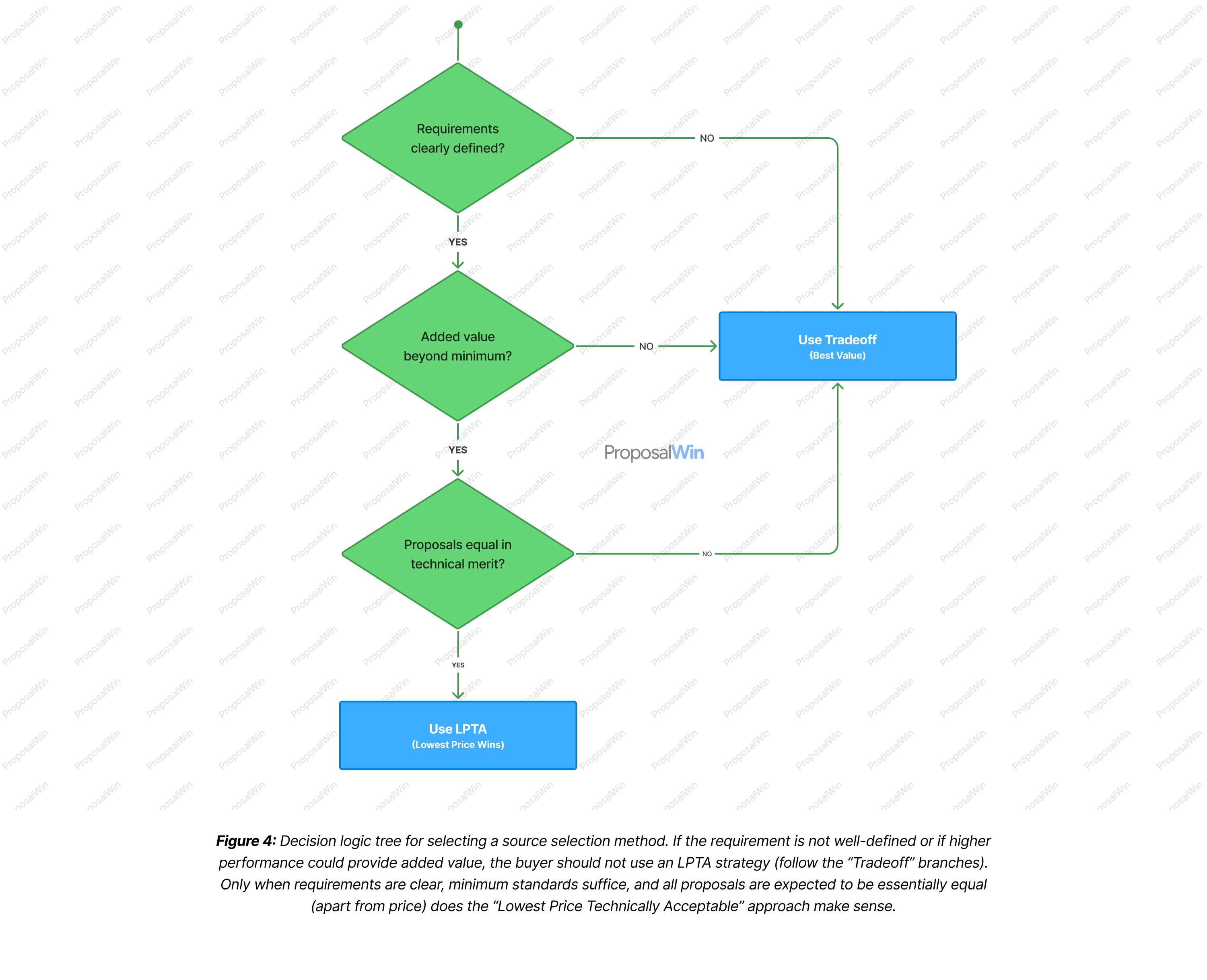
Figure 4 illustrates a decision logic diagram for choosing the source selection method. If any condition necessary for LPTA is not met (e.g. requirements are not crystal-clear, or proposals could offer added value beyond the minimum), then the buyer should pursue a best-value tradeoff instead of defaulting to lowest price. As depicted, only when the requirement is simple, well-defined, and no additional benefits would come from higher quality can LPTA be justified. In practice, many acquisitions fail to meet these criteria, which is why the lowest-price-wins approach is far from universal. Policy reinforces this: agencies are directed to avoid LPTA in situations requiring innovation, judgment, or high risk reduction. This logic ensures that the Government does not sacrifice important quality or performance advantages just to accept the lowest bid.
Another aspect is contract type selection, which also undercuts the ”lowest price” notion. In a firm fixed-price contract, offerors commit to a total price, but in other contract types like Time-and-Materials, the Government pays based on actual labor hours and materials used. With T&M, the true cost isn’t determined until the work is done. A contractor might propose low hourly rates (appearing cost-competitive), yet if the work takes many more hours, the final price to the Government can be much higher than a competing fixed price or a more efficient contractor. Recognizing this risk, the FAR labels T&M contracts as the “least preferred” type and allows them only when no other contract type is suitable. T&M awards require close Government oversight because there is no incentive for the contractor to control cost or labor efficiency under this model. This means that even if a contractor appears to offer the lowest rates, the Government cannot assume it will pay the lowest total price. Thus, simply picking a vendor with the lowest unit prices can be misleading in terms of actual cost to taxpayers.
Conclusion
In summary, while the allure of the lowest bid is strong, federal acquisition regulations and best practices reveal that the lowest price is often a myth when it comes to true best value. Through careful evaluation frameworks, decision logic, and appropriate contract choices, agencies strive to ensure that the selected contractor will deliver the optimal combination of price, quality, and performance. This means the Government frequently accepts a higher price for a better outcome, when justified. By avoiding LPTA in unsuitable situations and considering life-cycle costs and performance risk, the acquisition system aims to protect the Government’s interests and mission objectives. As one industry expert observed, applying LPTA restrictions government-wide “will ensure all Federal agencies are using the best procurement approach to access innovation ... and obtain better results and value for the taxpayer dollar”. In the end, source selection is about best value, not just lowest price: the myth that the lowest price always wins is dispelled by the reality of the FAR’s guidance and the Government’s commitment to smart procurement.

Smarter Proposals. Stronger Submissions.
Ready to Submit Stronger, Fully Compliant Proposals?
Join the agencies and contractors who trust ProposalWin to deliver faster, better, compliant proposals, and see how much smoother your next bid can be.